
Low-Sugar Drinks vs Water: Kids Drink More and Stay Hydrated
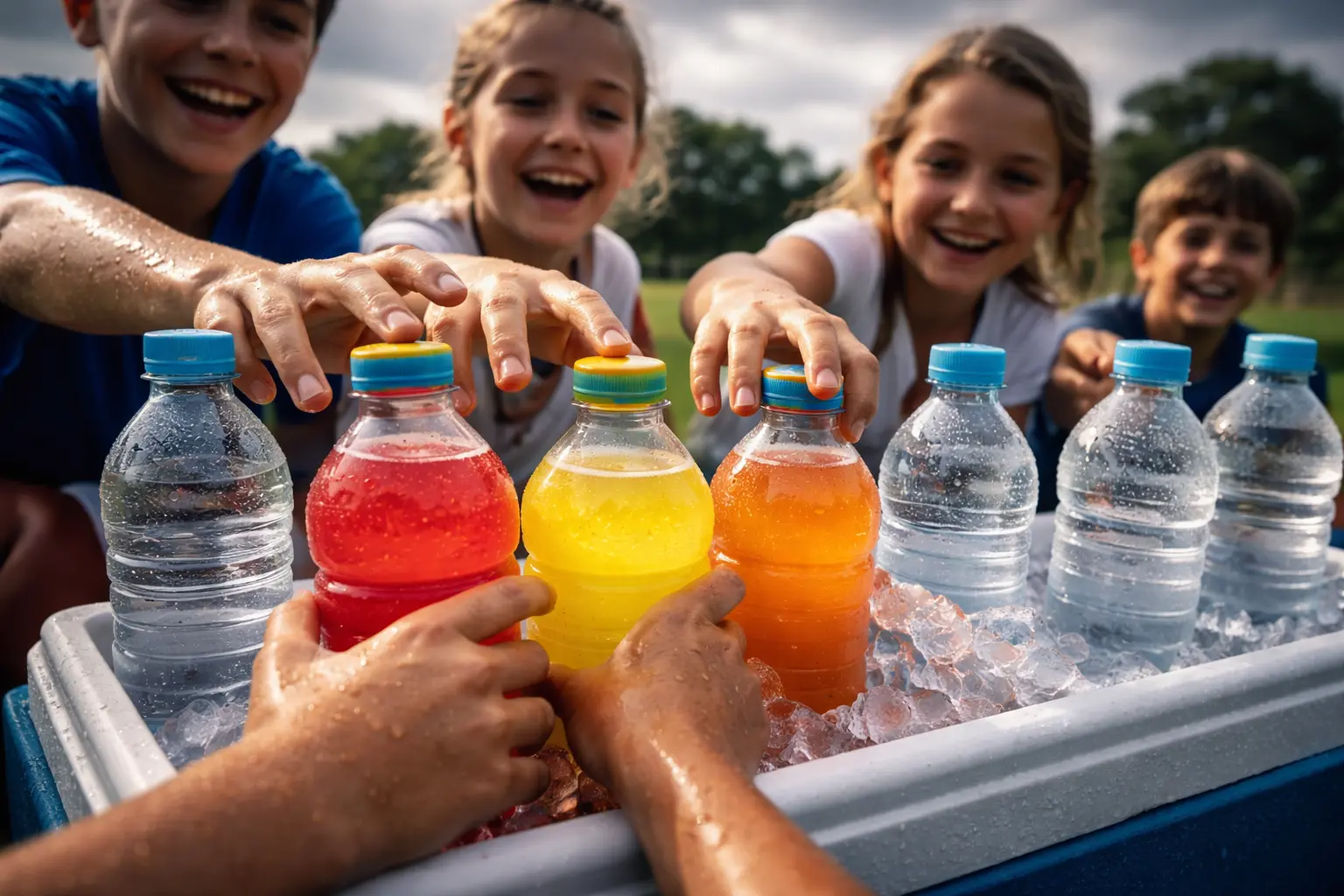
You've watched it happen countless times at youth sports practices, summer camps, and playground sessions on warm days. Kids run themselves ragged, sweating visibly, faces flushed from exertion and heat. Water bottles sit nearby, available and accessible. Yet when given breaks, many children barely take a sip before rushing back to play. By the end of the session, water bottles remain mostly full while kids show clear signs of heat stress and fatigue.
Parents and coaches know this pattern frustrates hydration efforts. You can't force kids to drink, and constantly reminding them to "take a water break" yields minimal compliance. The standard advice is simple: provide water, encourage regular drinking, and trust that kids will hydrate when needed. But what if they simply don't?
Inadequate fluid intake during prolonged activity in the heat isn't just uncomfortable - it increases risk of heat exhaustion, impairs exercise capacity, affects concentration, and in extreme cases can progress to serious heat illness. For children, whose thermoregulatory systems are still developing and who often don't recognize thirst cues as readily as adults, the stakes are real.
One proposed solution seems almost too simple: make the drink taste better. If kids won't drink enough water because it's boring, what if you offered something more appealing? Not high-sugar sports drinks that parents try to limit, but low-sugar flavored beverages that preserve palatability without excessive sweeteners.
Researchers in the exercise physiology and pediatric nutrition field directly tested this hypothesis. They recruited children aged 8-10 and had them complete two identical 3-hour exercise sessions in hot conditions (around 30°C). In one session, only plain water was available. In the other, they could drink a low-sugar flavored beverage whenever they wanted. Everything else - the exercise protocol, temperature, duration, beverage availability - remained constant. The only variable that changed was whether the drink tasted appealing.
The results were dramatic and consistent. Children drank roughly 128% more fluid when offered the flavored beverage compared to water. Nearly every child in the study showed this pattern. And the increased intake wasn't trivial - it translated into measurably better hydration status throughout the exercise session, including improved fluid balance and less concentrated urine.
The findings challenge a common assumption about children's hydration: that water is always the most practical option simply because it's the healthiest on paper.
The Research Question: Does Beverage Palatability Override Thirst Signals?
The study's objective was focused and practically motivated: determine whether children would drink more fluid and achieve better hydration during prolonged exercise in the heat if offered a palatable low-sugar flavored beverage instead of plain water.
Specifically, researchers tested whether access to a low-sugar flavored beverage, compared to plain water, would:
- Increase voluntary fluid intake - measured as total beverage volume consumed when children drink ad libitum (as much as they want)
- Improve hydration markers - assessed through net fluid balance (intake minus losses), urine volume, and urine concentration (osmolality)
This wasn't about optimizing athletic performance, replacing electrolytes, or testing high-sugar sports drinks. The focus was narrower and more fundamental: do kids simply drink more when the beverage tastes better, and does that increased intake meaningfully improve hydration status?
Why This Question Matters: If palatability drives drinking behavior more than physiological thirst in children, then providing plain water - while ideal from a nutritional purity standpoint - might be counterproductive for preventing dehydration if kids won't actually drink it. The practical goal is adequate hydration, not beverage purity.
Study Design: Controlled Crossover Isolating Palatability
Randomized Crossover Structure Eliminates Individual Variation
The researchers used a randomized, counterbalanced crossover design where each child completed both beverage conditions on separate days. This powerful design means each child served as their own control, eliminating variability from individual differences in:
- Baseline thirst sensitivity and drinking habits
- Sweat rate and fluid loss patterns
- Exercise intensity and activity preferences
- Body size and composition
The two experimental conditions:
| Condition | Beverage Type | Availability |
|---|---|---|
| Water (W) | Plain water, no flavor or sweetener | Ad libitum (drink as much as wanted) |
| Flavored Beverage (FB) | Low-sugar flavored drink, palatable taste | Ad libitum (drink as much as wanted) |
The order of conditions was randomized, with sufficient time between sessions (typically several days) to eliminate carryover effects. This ensures that results reflect the beverage difference, not order effects or residual hydration status from the previous session.
Participants: Typical Active Children
The study enrolled 21 healthy children with characteristics representing typical youth activity populations:
| Characteristic | Details |
|---|---|
| Total participants | 21 children |
| Age range | 8-10 years old |
| Gender distribution | 11 girls, 10 boys |
| Health status | No known medical conditions affecting hydration or exercise tolerance |
This age range is particularly relevant. Children aged 8-10 are commonly involved in organized sports, summer camps, and outdoor play, yet they often rely on adults to provide hydration opportunities and beverage choices. They're old enough to participate in structured exercise protocols but young enough that drinking behavior still requires external support and encouragement.
Exercise Protocol: Simulating Real-World Activity Patterns
The protocol was designed to simulate extended outdoor activity in warm conditions - the exact scenario where pediatric dehydration risk is highest:
Environmental conditions:
- Temperature: approximately 30°C (86°F)
- Environment: hot and dry (relevant to many summer outdoor settings)
Exercise structure (repeated 3 times over ~3 hours total):
- Walk for 10 minutes (moderate activity)
- Rest for 5 minutes (short break)
- Walk again for 10 minutes (moderate activity)
- Extended rest period of 35 minutes (mimicking typical practice/play structure with longer breaks)
This intermittent pattern reflects real youth activity better than continuous exercise. Kids don't run nonstop for hours - they have bursts of activity interspersed with rest periods when drinking opportunities typically occur.
During the entire 3-hour session, children had free access to their assigned beverage (either water or flavored drink) and could drink whenever they wanted, as much as they wanted. Researchers tracked total intake but didn't encourage, remind, or restrict drinking - mimicking natural beverage consumption patterns.
Comprehensive Hydration Measurements
Throughout each session, researchers tracked multiple hydration markers:
- Total fluid intake - volume consumed during the entire session
- Net fluid balance - intake minus losses (sweat, urine) at multiple time points
- Urine volume - total urine output during and after the session
- Urine osmolality - concentration of urine (higher osmolality indicates more concentrated urine and worse hydration status)
- Palatability ratings - subjective ratings of how much children liked the beverage
This comprehensive approach captures both how much kids drank and whether that intake translated into actual improvements in hydration status.
Results: Flavor Dramatically Increases Fluid Intake
Total Fluid Intake: Nearly Double With Flavored Beverages
The most striking and practically important finding was the sheer difference in how much children voluntarily drank:
| Beverage Condition | Average Intake (mL) | Difference |
|---|---|---|
| Low-Sugar Flavored Beverage | 946 ± 535 mL (~32 oz) | Reference |
| Plain Water | 531 ± 267 mL (~18 oz) | -44% less intake |
| Percent Increase | ~78% more with flavored beverage | |
Children drank approximately 128% more fluid with the flavored beverage compared to water. Put differently, they consumed roughly 415 mL (14 oz) additional fluid when the drink tasted appealing - nearly an extra pint of hydration over the 3-hour session.
This wasn't just a statistical average obscuring varied individual responses. The effect was remarkably consistent: 19 out of 21 children (90%) drank more during the flavored beverage condition than during the water-only condition. The pattern held across nearly the entire sample.
Practical Context: For a typical 8-10 year old child exercising in the heat for 3 hours, the difference between consuming 530 mL (barely two cups) versus 950 mL (over four cups) is substantial. That extra fluid intake could be the difference between maintaining adequate hydration versus progressive dehydration with associated performance and safety implications.
Net Fluid Balance: Better Hydration Status With Flavored Drinks
Drinking more fluid is only meaningful if it actually improves hydration status. The researchers tracked net fluid balance - the running tally of intake minus losses through sweat and urine - at multiple time points throughout the 3-hour session.
Key findings on fluid balance:
- Net fluid balance was significantly better with the flavored beverage at several interim time points, including around 60, 70, and 85 minutes into the protocol
- These differences indicate that higher intake with the flavored drink translated into more favorable hydration status during much of the exercise session
- Although neither condition fully prevented all fluid loss over the entire 3-hour period (some dehydration occurred in both), the flavored beverage consistently reduced the hydration deficit compared to water
This proves that the increased intake wasn't just passing through without improving hydration - it genuinely helped maintain better fluid status during the activity period when dehydration risk is highest.
Urine Measures: More Volume, Less Concentration With Flavor
Urine volume and concentration provide additional objective markers of hydration status. Well-hydrated individuals produce more urine that's less concentrated (lower osmolality). Dehydrated individuals conserve fluid by producing less urine that's more concentrated.
Urine volume findings:
| Beverage Condition | Urine Volume (mL) |
|---|---|
| Flavored Beverage | ~727 ± 291 mL |
| Plain Water | ~400 ± 293 mL |
Children produced significantly more urine when drinking the flavored beverage - indicating they had more fluid available to excrete rather than conserving every drop due to dehydration.
Urine osmolality (concentration):
- Urine osmolality was higher (more concentrated) during the water condition at multiple time points throughout the session
- More concentrated urine indicates the body is conserving fluid due to greater relative dehydration with the water-only condition
- Lower osmolality with the flavored beverage suggests better hydration status and less physiological stress from fluid deficit
Taken together, both urine volume and concentration measures support the conclusion that children were objectively better hydrated when they drank the low-sugar flavored beverage compared to plain water.
Palatability Ratings: Kids Simply Prefer Flavor
Unsurprisingly, children consistently rated the flavored beverage as more likable than water at every assessed time point during the protocol. This subjective preference directly aligns with the objective intake data.
The mechanism is straightforward: kids drank more because they liked the taste better. Palatability drove voluntary drinking behavior, overriding whatever physiological thirst signals might have been present. When the beverage was appealing, they drank enough to maintain better hydration. When it was plain water, they didn't.
What the Science Actually Proves
Within the well-defined scope of this randomized crossover trial, the evidence firmly supports two clear conclusions:
- Children drank significantly more fluid - approximately 128% more, or nearly double - when offered a low-sugar flavored beverage compared to plain water during prolonged intermittent exercise in hot conditions
- The higher intake improved hydration markers - including better net fluid balance during the activity period, greater urine volume, and less concentrated urine indicating reduced dehydration stress
These findings demonstrate that beverage choice meaningfully influences hydration outcomes in children during heat stress, even when sugar content is kept low. Palatability matters - not just for beverage preference, but for actual physiological hydration status.
Why Palatability Drives Drinking Behavior in Children
Developmental Differences in Thirst Regulation
Children aren't just small adults when it comes to hydration regulation. Several developmental factors make them more susceptible to inadequate fluid intake:
- Less developed thirst mechanisms - children often don't perceive thirst as intensely as adults relative to their hydration deficit
- Higher surface area to mass ratio - they heat up faster and lose proportionally more fluid through sweating
- Greater distraction during play - children become absorbed in activity and ignore thirst cues until dehydration is significant
- Limited understanding of consequences - they don't connect "feeling tired and hot" with "I need to drink more water"
Voluntary Dehydration Phenomenon
Exercise physiologists have documented a phenomenon called "voluntary dehydration" - people (especially children) don't voluntarily drink enough to match fluid losses during exercise, even when beverages are freely available. Several mechanisms contribute:
- Thirst lags behind physiological deficit - you're already 1-2% dehydrated by the time you feel thirsty
- Thirst is temporarily satisfied before full rehydration - a few sips quench the sensation even if fluid deficit remains
- Competing motivations - desire to return to play overrides drinking behavior
Palatability appears to partially overcome voluntary dehydration by providing additional motivation to drink beyond just thirst. When the beverage tastes good, children drink more proactively rather than waiting for intense thirst signals.
Practical Psychology: Remove Barriers, Add Incentives
From a behavioral perspective, the flavored beverage reduces the "cost" of drinking (making it more pleasant rather than a chore) and adds an "incentive" (taste reward). This shifts the behavior from something kids need to be reminded to do toward something they're more willing to do spontaneously.
What This Study Does NOT Prove
To avoid overinterpretation and clearly define the evidence boundaries:
Not Compared: Low-Sugar Drinks vs Sports Drinks
The study compared a low-sugar flavored beverage to plain water. It does not establish whether similar benefits would occur with:
- Traditional high-sugar sports drinks (which might increase intake further but with greater sugar content)
- Electrolyte solutions or rehydration beverages
- Different flavoring approaches or sweetener types
Not Assessed: Long-Term Outcomes or Habituation
The trial examined hydration during single 3-hour sessions on two separate days. It does not address:
- Whether children would continue to drink more over weeks or months
- Whether flavor preference would diminish with repeated exposure (habituation)
- Long-term health effects on dental health, taste preferences, or dietary patterns
- Whether providing flavored drinks "spoils" children's willingness to drink water later
Not Disentangled: Flavor vs Sweetness vs Expectation
The study used a low-sugar flavored beverage but didn't systematically test whether increased intake was driven by:
- Sweetness alone (even in low amounts)
- Flavor complexity independent of sweetness
- Color or appearance
- Novelty or expectation effects
These components weren't isolated, so we can't definitively say which aspect of palatability matters most.
Not Generalized Beyond Narrow Population
Participants were healthy children aged 8-10 years. Findings may not extend to:
- Younger children - different sweat rates and drinking behaviors
- Adolescents or adults - more developed thirst regulation
- Different climates - humid heat vs dry heat affects fluid needs differently
- Longer duration activities - marathons, all-day tournaments, multi-day camps
Practical Applications for Parents, Coaches, and Caregivers
Rethinking the "Water Only" Approach
Many parents and youth sports programs adopt a "water only" policy, avoiding any sweetened beverages during activity. The rationale is understandable - limit sugar intake, promote healthy habits, avoid empty calories. But this study suggests that policy might backfire if the result is inadequate fluid intake.
When dehydration risk is real - during prolonged outdoor activity in warm weather - the practical goal should be adequate hydration first, beverage purity second. A child who drinks 950 mL of low-sugar flavored beverage is better hydrated and safer than a child who drinks 530 mL of water because they find it boring.
Practical Strategies for Improving Youth Hydration
Based on this evidence, caregivers can implement several practical approaches:
- Offer low-sugar flavored beverages during high-risk situations - save them for extended outdoor activity in the heat, not everyday at-home hydration
- Choose formulations with minimal sugar - aim for less than 5-10g sugar per serving, avoiding traditional sports drinks with 20-30g
- Consider water flavor enhancers - sugar-free flavor drops or packets can make water more appealing without added sweeteners
- Rotate beverage types - use flavored drinks strategically rather than exclusively, maintaining water exposure in lower-risk settings
- Monitor actual intake, not just availability - providing water isn't enough; track whether kids are actually drinking it
- Make beverages cold and accessible - temperature and convenience both affect intake independent of flavor
When Palatability Matters Most
The benefits of flavored beverages are most relevant in specific high-risk contexts:
- Youth sports practices and games - especially outdoor sports during warm months
- Summer camps and field trips - all-day outdoor activities with limited shade
- Physical education classes during heat waves - when schools may lack adequate cooling
- Extended family outdoor activities - hiking, beach days, amusement parks in hot weather
In lower-risk settings - indoor play, short activities, cool weather, home hydration throughout the day - plain water remains perfectly appropriate and should be encouraged as the default.
Balancing Hydration With Sugar Concerns
Parents understandably worry about sugar intake. The key is recognizing that low-sugar flavored beverages used strategically for hydration during activity are different from high-sugar sodas or juice consumed throughout the day.
Context matters:
| Scenario | Priority | Recommended Approach |
|---|---|---|
| Extended exercise in heat | Prevent dehydration | Low-sugar flavored beverage if it increases intake |
| Daily at-home hydration | Build healthy habits | Plain water, unsweetened |
| Meals and snacks | Limit added sugars | Water or milk, not sweetened drinks |
| Short indoor activity | Normal hydration | Plain water sufficient |
Using low-sugar flavored beverages strategically - specifically during periods of highest dehydration risk - doesn't undermine overall dietary quality and may prevent more serious problems from inadequate hydration.
Study Limitations Worth Noting
Controlled Lab vs Real-World Complexity
The study was conducted in controlled conditions with standardized exercise protocols. Real-world youth activity involves:
- Variable exercise intensity (kids playing unpredictably rather than walking on schedule)
- Distraction and social factors affecting drinking behavior
- Less structured beverage availability and reminders
- Longer durations or multiple consecutive days of activity
Whether the 128% increase in intake would fully translate to chaotic soccer tournaments or summer camps is uncertain, though the underlying palatability mechanism should still operate.
Single-Day Measurements
Each condition was tested once per child over a 3-hour session. The study doesn't address:
- Day-to-day variability in children's drinking behavior
- Cumulative hydration status over multiple days
- Whether initial novelty of the flavored drink inflated intake
Lack of Performance or Health Outcome Measures
The study measured hydration markers but not:
- Athletic performance or endurance capacity
- Heat tolerance or thermal stress
- Subjective feelings of fatigue, alertness, or well-being
- Actual heat illness incidence
While better hydration logically should improve these outcomes, they weren't directly tested.
The Bigger Picture: Practical Efficacy vs Theoretical Purity
This study exemplifies a recurring tension in nutritional and public health guidance: the gap between what's theoretically ideal and what actually works in practice.
Theoretically, plain water is the ideal hydration source - zero calories, no added sugars, universally available, free from most sources. Public health messaging correctly emphasizes water as the default beverage for children. From a nutritional purity standpoint, encouraging water consumption makes perfect sense.
But theory meets reality when kids simply don't drink the water you provide. If the result is that children remain inadequately hydrated during activity periods when dehydration risk is substantial, then the theoretically ideal approach produces practically poor outcomes.
The pragmatic perspective asks: what's the actual goal? If the goal is promoting water consumption as an abstract principle, then water-only policies succeed by definition. But if the goal is ensuring children stay adequately hydrated during high-risk heat exposure, then providing a beverage they'll actually drink - even if it contains modest flavoring and sweetness - may better achieve the underlying objective.
This doesn't mean abandoning water or embracing high-sugar drinks indiscriminately. It means recognizing that in specific high-stakes contexts where dehydration risk is elevated and water intake remains stubbornly low, strategic use of palatable low-sugar alternatives is an evidence-based harm-reduction approach.
Summary: Palatability Drives Pediatric Hydration
This randomized crossover trial provides clear, actionable evidence for a common practical problem in youth activity management.
Primary finding: Children aged 8-10 years drank approximately 128% more fluid (946 mL vs 531 mL) when offered a low-sugar flavored beverage compared to plain water during 3 hours of intermittent exercise in hot conditions (30°C). The increased intake translated into measurably better hydration status, including improved net fluid balance, greater urine volume, and less concentrated urine indicating reduced dehydration stress.
Mechanism: Palatability fundamentally drives voluntary drinking behavior in children, who have less developed thirst mechanisms and greater susceptibility to voluntary dehydration during activity. When beverages taste appealing, children drink more proactively rather than waiting for intense thirst cues that may arrive too late. The increased intake overrides the natural tendency to underdrink during exercise, particularly in age groups that become absorbed in play and ignore physiological signals.
Practical implication: For parents, coaches, and caregivers managing children during extended outdoor activity in warm weather, offering low-sugar flavored beverages is an evidence-based strategy for improving hydration outcomes when plain water consumption remains inadequate. This approach balances dehydration risk reduction with reasonable limits on added sugar intake. Strategic use of palatable beverages during high-risk situations (prolonged heat exposure, intense activity, limited shade) complements rather than replaces promotion of plain water as the everyday default beverage.
Bottom line: The "water only" approach to youth hydration is theoretically sound but practically limited if kids won't drink enough of it when dehydration risk is real. Nearly doubling fluid intake by making the beverage taste better - without resorting to high-sugar sports drinks - represents a pragmatic harm-reduction strategy. When your child is playing soccer in 86°F heat for three hours and their water bottle comes back full, the problem isn't that they lack discipline or don't understand hydration. The problem is that you're fighting their natural physiology and developmental stage. A low-sugar flavored drink they'll actually consume is better than pristine water they'll ignore. Hydration adequacy matters more than beverage purity when the alternative is dehydration. Choose your battles wisely - save the water-only policy for everyday contexts where dehydration risk is low, and strategically deploy palatability when heat stress makes adequate fluid intake non-negotiable.
References and Further Reading
- Bar-Or O, Dotan R, Inbar O, Rothstein A, Zonder H. Voluntary hypohydration in 10- to 12-year-old boys. Journal of Applied Physiology. 1980;48(1):104-108. PMID: 7353964
- Wilk B, Bar-Or O. Effect of drink flavor and NaCl on voluntary drinking and hydration in boys exercising in the heat. Journal of Applied Physiology. 1996;80(4):1112-1117. PMID: 8926233
- Rivera-Brown AM, Gutierrez R, Gutierrez JC, Frontera WR, Bar-Or O. Drink composition, voluntary drinking, and fluid balance in exercising, trained, heat-acclimatized boys. Journal of Applied Physiology. 1999;86(1):78-84. PMID: 9887116