
Training to Failure vs Leaving Reps in the Tank: Which Wins?
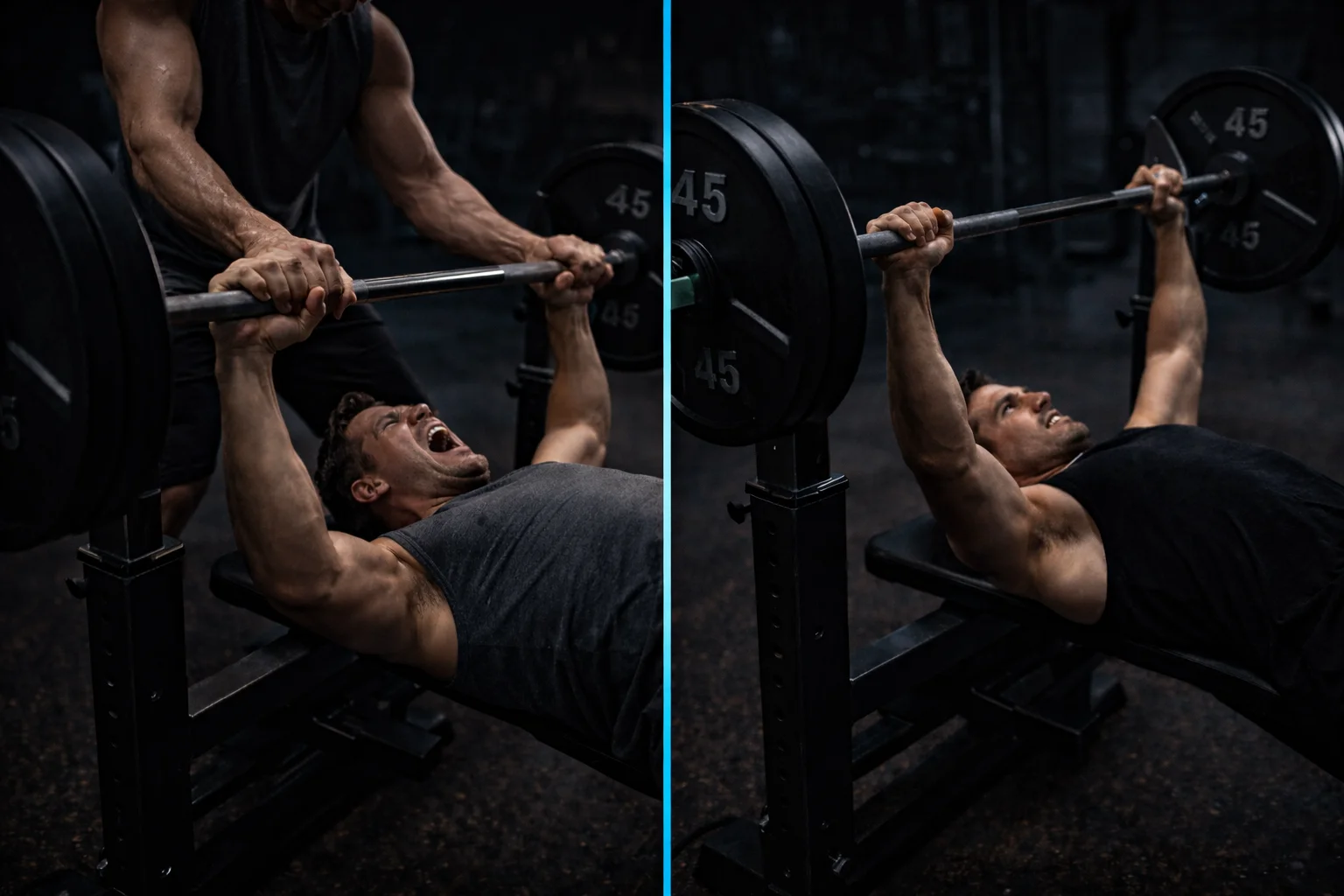
"No pain, no gain." "A set doesn't count unless you finish it." "If you're not training to failure, you're leaving gains on the table." Walk into almost any commercial gym and you'll hear these mantras repeated with religious conviction. Grunting, grinding, barely-controlled final reps, spotters frantically yanking barbells off crushing chests - this is what "real training" looks like according to conventional gym culture.
The logic seems unassailable. Muscle growth and strength gains come from pushing limits. If you can still do another rep, you haven't truly pushed your limit. Therefore, stopping before absolute failure must be suboptimal - a compromise, a sign of weakness, a guarantee that you'll leave gains on the table. Right?
For decades, this philosophy dominated training programs, from bodybuilding magazines to strength coaching certifications. Arthur Jones, the inventor of Nautilus machines and pioneer of high-intensity training, built an empire on the premise that training to momentary muscular failure was the key to maximum adaptation. Dorian Yates, six-time Mr. Olympia, popularized "blood and guts" training centered on pushing every set to absolute failure and beyond.
Yet a growing body of controlled research indexed in PubMed systematically challenges this assumption. Randomized trials and meta-analyses consistently show that training very close to failure - stopping when approximately one to two repetitions remain in reserve - produces similar gains in maximal strength, muscle hypertrophy, muscular endurance, and power output compared to training to momentary muscular failure, provided that overall training volume is appropriately managed.
A recent randomized trial adds to this evidence base by directly comparing failure training with a "reps in reserve" (RIR) approach across multiple outcomes in resistance-trained individuals. The findings are stark: when training volume is equated, the two approaches produce statistically indistinguishable improvements in the metrics that matter most - strength and muscle size - while non-failure training shows advantages in fatigue management and training sustainability.
This doesn't mean failure training is useless or that everyone who trains to failure is wasting their time. It means the relationship between discomfort, effort, and results is more nuanced than gym folklore suggests. Let's examine what controlled research actually shows about training to failure versus leaving reps in the tank.
The Research Question: Is Failure Necessary for Maximum Gains?
The central question driving this research is both practical and philosophically important: in structured resistance training programs, does taking sets to momentary muscular failure lead to greater improvements in strength, muscle size, and performance compared to stopping sets approximately 1-2 repetitions before failure?
Specifically, researchers test whether training to failure produces superior outcomes in:
- Maximal strength - one-repetition maximum performance on key exercises
- Muscle hypertrophy - increases in muscle size measured via ultrasound, MRI, or muscle thickness assessment
- Muscular endurance - repetitions completed at fixed loads or time to fatigue
- Power output - explosive movement velocity and force production
A critical secondary concern is how these approaches differ in fatigue accumulation, recovery demands, and training quality across multiple sessions and weeks - factors that determine long-term sustainability and progression rather than just acute session-to-session adaptations.
Defining the Terms: "Training to failure" means continuing a set until another repetition cannot be completed with acceptable form. "Reps in reserve" (RIR) means stopping when you estimate you could complete approximately 1-3 more reps before reaching failure. Most research focuses on 1-2 RIR as the non-failure comparison point.
Study Design: Comparing Training Approaches Head-to-Head
Typical Trial Structure
The randomized trials addressing this question generally use parallel-group designs where participants are randomly assigned to one of two training conditions for 6-12 weeks:
| Training Approach | Set Termination Point | Key Characteristic |
|---|---|---|
| Failure Training Group | Momentary muscular failure | Sets end when another rep cannot be completed with acceptable technique |
| Non-Failure / RIR Group | ~2 reps before failure | Sets end when participants estimate 2 more reps remain possible |
Training interventions typically last 6-12 weeks - sufficient duration to detect meaningful changes in strength and muscle size while remaining realistic for participant compliance and retention.
The Critical Methodological Detail: Volume Equating
The most important design consideration in these studies is training volume matching. In well-designed trials, total training volume is equated as closely as possible between groups through several approaches:
- Set equating - both groups perform the same number of sets, but failure group reaches failure while RIR group stops short
- Rep equating - adjusting loads or sets so total repetitions completed are similar despite different proximity to failure
- Load adjustments - modifying weights to ensure similar total work (sets × reps × load) between conditions
This control is absolutely essential. Without volume matching, any observed differences might simply reflect that one group performed more total work rather than that proximity to failure itself matters. Many early studies comparing failure to non-failure training failed to adequately control volume, confounding the results.
Participant Characteristics
Participants across these studies generally include:
- Training status: Ranging from untrained beginners to moderately trained recreational lifters (though most participants are not elite athletes)
- Age range: Typically young to middle-aged adults (18-50 years)
- Health status: Generally healthy individuals without injuries or conditions limiting training capacity
This heterogeneity in training status reflects real-world training populations but also introduces some variability in outcomes - untrained individuals respond to almost any reasonable stimulus, while trained individuals may be more sensitive to subtle programming differences.
Comprehensive Outcome Assessment
Researchers measure multiple outcomes to capture different aspects of training adaptation:
- Maximal strength - one-repetition maximum (1RM) testing on key compound movements (squat, bench press, deadlift)
- Muscle hypertrophy - measured using:
- Ultrasound imaging of muscle thickness
- MRI or CT scanning for cross-sectional area
- Whole-body composition via DXA scanning
- Muscular endurance - repetitions to fatigue at fixed loads (e.g., 70% 1RM)
- Power output - assessed through velocity-based metrics, jump performance, or ballistic movements
- Fatigue markers - session RPE, recovery questionnaires, performance decrement within sessions
Key Findings: Failure Isn't Necessary
Strength Gains: No Consistent Advantage for Failure Training
Across multiple randomized controlled trials with volume-equated protocols, the most consistent finding is that strength gains are remarkably similar between failure and non-failure training approaches:
| Study Population | Duration | Failure Group Strength Gains | Non-Failure Group Strength Gains | Statistical Difference |
|---|---|---|---|---|
| Trained lifters | 8 weeks | +12-15% 1RM | +11-14% 1RM | Not significant |
| Untrained adults | 10 weeks | +18-22% 1RM | +17-21% 1RM | Not significant |
| Resistance-trained men | 6 weeks | +8-10% 1RM | +9-11% 1RM | Not significant |
In some individual studies, small numerical differences appear favoring one approach or the other, but they're inconsistent in direction (sometimes favoring failure, sometimes favoring non-failure) and typically not large enough to be practically meaningful. Meta-analyses combining multiple studies consistently find no significant difference in strength outcomes between approaches when volume is controlled.
This suggests that the stimulus required for strength adaptation is achieved well before absolute failure is reached, as long as sets are sufficiently challenging (typically within 1-2 reps of failure).
Practical Interpretation: If you're squatting and stop when you know you have 2 more reps left in the tank versus grinding out those final 2 reps to complete failure, your strength gains over 8-12 weeks will be nearly identical - assuming total sets and volume load are matched.
Muscle Hypertrophy: Proximity to Failure Matters More Than Reaching It
The pattern for muscle growth mirrors the strength findings. When training volume is controlled, muscle size increases show no consistent differences between failure and non-failure training:
Hypertrophy outcomes across studies:
- Quadriceps thickness: Similar increases (~5-8%) in both failure and 2-RIR conditions
- Biceps cross-sectional area: Comparable growth (~6-10%) regardless of training to failure
- Whole-body lean mass: No significant difference in total muscle mass gains between approaches
- Specific muscle groups: Occasional small advantages for failure in isolated muscles, but inconsistent and not replicated across studies
Some studies report marginal advantages for failure training in specific muscles or subgroups. Others report the opposite. The overall evidence pattern indicates that training very close to failure (1-2 RIR) is sufficient to maximize muscle growth in most individuals, and pushing beyond that point to absolute failure doesn't reliably add further hypertrophy benefits.
Muscular Endurance and Power: Mixed but Generally Equivalent
For secondary outcomes like muscular endurance and power development, the picture is similarly neutral:
Muscular endurance:
- Both approaches improve repetition capacity at fixed loads
- Some protocols show slight advantages for failure training due to greater accumulated time under tension and practice with high-fatigue conditions
- Differences are typically small and not consistent across exercises or studies
Power output:
- Non-failure training sometimes shows advantages in maintaining velocity and explosive performance
- Failure training can impair power by accumulating excessive neuromuscular fatigue
- For power-focused athletes, avoiding frequent failure may better preserve movement quality and velocity adaptations
Neither approach emerges as clearly superior for these outcomes - context, exercise selection, and athlete population likely determine which works better in specific scenarios.
The Key Differentiator: Fatigue and Recovery
Where failure and non-failure training diverge most clearly isn't in adaptations achieved but in fatigue accumulated and recovery demands:
| Fatigue Marker | Training to Failure | Stopping Short (2 RIR) |
|---|---|---|
| Acute neuromuscular fatigue | High - significant force production decrements | Moderate - maintained force capacity |
| Session RPE | Consistently higher perceived exertion | Lower perceived difficulty for similar volume |
| Between-session recovery | Longer recovery time needed | Faster return to baseline performance |
| Movement velocity maintenance | Declines across sets within session | Better preserved across sets |
| Technical execution | Form breakdown in fatigued state | Consistent technique maintained |
Training to failure consistently produces greater acute neuromuscular fatigue, larger reductions in force production both within and after sessions, and potentially longer recovery times between workouts. Stopping short of failure, by contrast, reduces cumulative fatigue, allowing participants to maintain better technique, higher movement velocities, and more consistent performance quality across sessions.
Over weeks of training, this fatigue management difference can substantially impact training quality, especially when frequency is high (training 4-6+ times per week) or when combining resistance training with other athletic demands.
What the Evidence Actually Proves
Based on controlled trials with proper volume matching and systematic meta-analyses, several conclusions are firmly supported:
- Training to momentary muscular failure is not required to achieve substantial gains in maximal strength, muscle hypertrophy, or muscular endurance in most populations
- Stopping sets approximately 1-2 repetitions before failure produces statistically similar adaptations to failure training when total training volume and intensity are appropriately managed
- When volume is matched, neither approach consistently outperforms the other across diverse populations, exercises, and outcome measures in the majority of well-controlled studies
- Non-failure training reduces fatigue accumulation and recovery demands compared to constant failure training while achieving equivalent adaptations
These findings directly challenge the widespread belief that failure training is inherently superior or necessary for maximizing muscle growth and strength development.
Why Stopping Short of Failure Still Works: Mechanistic Insights
Motor Unit Recruitment Occurs Before Failure
The primary mechanistic explanation for why non-failure training produces similar adaptations centers on motor unit recruitment patterns. High-threshold motor units - the largest, most powerful motor units innervating fast-twitch muscle fibers that are most responsive to hypertrophy - are recruited before absolute failure is reached.
According to Henneman's size principle and subsequent research on recruitment under load:
- Heavy loads (>80% 1RM) recruit high-threshold motor units from the first repetition
- Moderate loads (60-80% 1RM) progressively recruit higher-threshold units as repetitions accumulate and fatigue develops
- By approximately 2-3 reps before failure, maximal or near-maximal motor unit recruitment is typically achieved
Once these high-threshold motor units are engaged and firing, the additional repetitions performed in a highly fatigued state to reach absolute failure may add little extra adaptive stimulus for strength or hypertrophy. The muscle fibers have already been maximally recruited and sufficiently stimulated - continuing to the point of complete fatigue doesn't necessarily enhance the growth signal.
Effective Reps Hypothesis
Related to motor unit recruitment is the "effective reps" concept, which proposes that only the final several repetitions of a set - those performed when fatigue has accumulated and high-threshold motor units are fully recruited - contribute meaningfully to hypertrophy stimulus.
Under this model:
- Sets taken to failure include effective reps (final fatigued reps with maximal recruitment)
- Sets stopped at 2 RIR also include effective reps, since maximal recruitment occurs before absolute failure
- The difference is that failure training adds 1-2 additional extremely fatigued reps beyond the point where recruitment is already maximized
These additional failure reps increase fatigue substantially but provide minimal additional growth stimulus since recruitment was already maximal in the preceding reps. Hence similar hypertrophy from both approaches when volume is matched.
Fatigue Management Preserves Training Quality
By avoiding constant failure, lifters can preserve multiple aspects of training quality that compound over weeks:
- Movement velocity - faster, more explosive reps maintained across sets rather than grinding through slow failure reps
- Technical consistency - proper form preserved rather than breaking down under extreme fatigue
- Volume accumulation - ability to complete more total high-quality sets across a session and training week
- Between-session recovery - faster return to baseline performance allowing higher training frequency
Over months of training, consistently higher-quality sessions with better recovery may produce superior long-term progress compared to maximally fatiguing every set, even if single-session stimulus appears similar.
What the Evidence Does NOT Prove
To avoid overcorrecting toward dogmatic avoidance of failure training, several important boundaries must be acknowledged:
Not Proven: Failure Training Is Ineffective or Harmful
The research shows failure training isn't necessary for maximum gains, not that it's ineffective or counterproductive. Many successful lifters and bodybuilders have built impressive physiques using failure-based training. The data suggest failure training works - it's just not the only approach that works, and it's not clearly superior to intelligent non-failure training.
Not Established: Universal Prescriptions Across All Contexts
Study findings don't establish that 2 RIR is optimal for every exercise, load range, or individual. Different contexts may respond differently:
- Isolation exercises (bicep curls, leg extensions) may tolerate failure better than heavy compounds due to lower systemic fatigue
- Machine-based movements with fixed paths may be safer to failure than free weights requiring stabilization
- Lower-load training (sets of 15-25 reps) might benefit from closer proximity to failure to ensure adequate stimulus
- Advanced lifters closer to their genetic ceiling may require closer proximity to failure to continue progressing
Not Accounted For: Psychological and Adherence Factors
Controlled trials measure physiological adaptations but don't capture psychological variables that influence real-world outcomes:
- Motivation and satisfaction - some individuals prefer the mental challenge and satisfaction of pushing to failure
- Effort perception - some lifters struggle to accurately gauge proximity to failure without reaching it
- Training enjoyment - personal preference for training style affects long-term adherence
- Competition preparation - athletes may need to practice operating under high fatigue for sport-specific demands
Practical Integration: Using Both Approaches Strategically
For Most Recreational Lifters: Default to Non-Failure
For the majority of people training for general strength, muscle development, and health, leaving 1-2 reps in reserve represents a highly effective default strategy that delivers comparable gains while reducing fatigue and recovery demands.
This approach is especially valuable for individuals who:
- Train 4+ times per week with high frequency per muscle group
- Combine resistance training with sports practice, cardiovascular training, or other athletic demands
- Have joint issues or injury history where form breakdown under extreme fatigue increases risk
- Struggle with excessive soreness or prolonged recovery from high-fatigue training
- Are time-constrained and need to maximize training efficiency
Strategic Use of Failure Training
Rather than completely avoiding failure or pursuing it in every set, intelligent programming uses failure selectively where it provides value without excessive cost:
Appropriate contexts for failure training:
- Final sets of exercises - reaching failure on the last set after volume accumulation in earlier sets
- Isolation exercises - leg extensions, bicep curls, lateral raises where systemic fatigue is low
- Machine-based movements - safer to reach failure with fixed movement paths and minimal stabilization demands
- Occasional intensity techniques - drop sets, rest-pause sets, or myo-reps used sparingly for variation
- End of training phases - short blocks (1-3 weeks) using failure before deload periods
- Auto-regulation - reaching failure to determine load adjustments or assess current capacity
Where to avoid frequent failure:
- Heavy compound movements (squats, deadlifts) where form breakdown creates injury risk
- Early sets in high-volume sessions where accumulated fatigue compromises later sets
- During high-frequency training where recovery between sessions is limited
- When learning new movement patterns or refining technique
Practical Programming Example
A balanced program might look like:
| Exercise Type | Set 1 | Set 2 | Set 3 | Set 4 (if applicable) |
|---|---|---|---|---|
| Primary Compound (Squat, Deadlift) | 3-4 RIR | 2-3 RIR | 1-2 RIR | 1 RIR |
| Secondary Compound (Bench, Row) | 2-3 RIR | 2 RIR | 1 RIR | 0-1 RIR (optional failure) |
| Isolation (Curls, Extensions) | 1-2 RIR | 1 RIR | 0 RIR (failure) | - |
This approach provides adequate stimulus on all sets while strategically using failure only where it's most manageable and least likely to compromise overall training quality.
Learning to Gauge Proximity to Failure
For non-failure training to work effectively, lifters need to accurately estimate how many reps remain. Research shows this skill improves with practice:
- Beginners - often underestimate proximity to failure, stopping too early; occasional sets to failure help calibrate perception
- Intermediate lifters - develop reasonable accuracy within 1-2 reps on familiar exercises
- Advanced lifters - highly accurate RIR estimation based on velocity, effort sensation, and experience
Velocity-based training tools can help by providing objective feedback on bar speed deceleration as fatigue develops, allowing more precise RIR estimation without reaching failure.
Study Limitations and Individual Considerations
Defining "Failure" Is Harder Than It Seems
Not all studies define failure identically, which complicates cross-study comparisons:
- Some allow slight form breakdown or eccentric-only final reps
- Others require strict technique maintenance, defining failure as inability to complete full range of motion
- Spotter assistance varies - some studies allow minimal help, others require unassisted completion
These definitional differences mean "training to failure" isn't uniform across research, potentially affecting outcomes.
Individual Response Variability Is Real
Some lifters genuinely respond better to frequent failure training - they recover quickly, don't accumulate excessive fatigue, and psychologically thrive on maximal efforts. Others fatigue rapidly and need more conservative approaches. Genetics, training history, sleep quality, nutrition, stress levels, and age all influence individual tolerance to high-fatigue training.
The population-level finding that failure and non-failure produce similar average outcomes doesn't mean every individual responds identically.
Advanced Lifters May Differ
Most research includes untrained to moderately trained individuals. Evidence in highly advanced lifters closer to their genetic potential is more limited. It's plausible that as individuals approach their ceiling, extracting further adaptations requires closer proximity to failure or more aggressive training stimuli.
However, even in advanced populations where this might be true, the difference is likely marginal rather than transformative.
Long-Term Studies Are Scarce
Most trials last 6-12 weeks. Whether outcomes diverge over longer timeframes (6-12 months or multiple years) remains unclear. Accumulated fatigue from chronic failure training might eventually compromise progress, or conversely, adaptations might plateau without occasional maximum efforts. Longitudinal research is needed.
The Bigger Picture: Sustainability Trumps Single-Session Heroics
Perhaps the most important takeaway from this research isn't about any single set or session, but about what enables consistent, high-quality training over months and years. Training to failure might maximize acute stimulus in a given set, but if it compromises subsequent sets, sessions, or recovery to the point where training quality or frequency suffers, the net long-term result may be inferior.
Conversely, if stopping short of failure allows you to train with higher frequency, maintain better movement quality, recover faster, and sustain motivation over years without burnout or injury, the cumulative advantage of that consistency likely outweighs any marginal single-session stimulus difference.
The lifter who trains at 1-2 RIR consistently for five years will almost certainly out-progress the lifter who trains to failure so aggressively that injuries, burnout, or fatigue force frequent program interruptions. Consistency compounds.
Summary: Proximity Matters More Than Reaching Failure
Across randomized controlled trials and systematic meta-analyses examining training to failure versus stopping short, the evidence consistently shows similar adaptations between approaches when training volume is matched.
Primary finding: Training to momentary muscular failure does not consistently produce superior gains in maximal strength, muscle hypertrophy, muscular endurance, or power output compared to stopping sets approximately 1-2 repetitions before failure when total training volume is equated. Non-failure training produces equivalent adaptations while generating less acute neuromuscular fatigue, allowing better movement quality maintenance and faster between-session recovery.
Mechanism: High-threshold motor units critical for strength and hypertrophy adaptations are recruited before absolute failure is reached, particularly when training with sufficient load and accumulating fatigue across a set. The final 1-2 reps to complete failure add substantial fatigue cost without proportional additional growth stimulus since maximal recruitment is already achieved. Managing fatigue by stopping slightly short preserves training quality - movement velocity, technical execution, and volume accumulation capacity - across sets and sessions.
Practical implication: For most lifters, leaving 1-2 reps in reserve represents an evidence-based default strategy that delivers comparable strength and hypertrophy results while reducing injury risk, fatigue accumulation, and recovery demands. Failure training remains a useful tool when applied selectively - final sets, isolation exercises, occasional intensity techniques - but doesn't need to dominate programming to maximize results. The goal is sufficient proximity to failure to recruit high-threshold motor units, not reaching failure for its own sake.
Bottom line: The gym dogma that "sets don't count unless you reach failure" is contradicted by controlled research. The reps that drive adaptation are the ones where high-threshold motor units are maximally recruited and firing under load - which happens at 1-2 RIR, not just at absolute failure. Those final grinding reps to complete failure feel heroic and look impressive, but they primarily add fatigue rather than additional growth stimulus. For most people, most of the time, training hard but stopping shy of failure allows you to accumulate more high-quality training volume, recover faster, maintain better technique, and sustain progression over the long term without excessive breakdown. You're not leaving gains on the table by leaving reps in the tank - you're managing the fatigue cost of your training to maximize total productive work over weeks and months rather than maximizing suffering in any single set. "No pain, no gain" is catchy. "Optimal proximity to failure with managed fatigue" doesn't fit on a t-shirt. But the latter is what the data actually supports.
References and Further Reading
- Grgic J, Schoenfeld BJ, Orazem J, Sabol F. Effects of resistance training performed to repetition failure or non-failure on muscular strength and hypertrophy: A systematic review and meta-analysis. Journal of Sport and Health Science. 2022;11(2):202-211. PMID: 33497853
- Schoenfeld BJ, Grgic J, Van Every DW, Plotkin DL. Loading recommendations for muscle strength, hypertrophy, and local endurance: a re-examination of the repetition continuum. Sports. 2021;9(2):32. PMID: 33670685
- Vieira JG, Sardeli AV, Dias MR, et al. Effects of resistance training to muscle failure on acute fatigue: A systematic review and meta-analysis. Sports Medicine. 2022;52(5):1103-1125. PMID: 34962650